





“An Actor is Finished If He Can’t Take the Stage.”Driven by that Conviction, Kuranosuke Sasaki is Breaking New Ground in a Play Imbued with the Spirit Of Eastern Europe.
Guests of the RIHGA Royal Hotel Kuranosuke Sasaki, Actor
Active across film, television, and theater, actor Kuranosuke Sasaki’s latest stage work is Jonah, a celebrated play by Marin Sorescu, a poet beloved by the people of Romania. Based on the Old Testament story of Saint Jonah, the play was directed by the Romanian theater great Silviu Purcărete and toured six cities across four European countries. Kuranosuke performed the play as a monodrama, and his powerful performance was a great success, moving audiences throughout Europe. We asked Kuranosuke about his state of mind, in fall 2025, as he finally takes the stage in Japan for his homecoming performance.
Experiencing a rare stage performance where the hearts of the actor and audience resonate together and mutual emotion swirls, transcending language barriers
On June 26, 2025, Kuranosuke performed Jonah at the Sibiu International Theatre Festival in Romania and received a star on the Walk of Fame, an honor given to those who have contributed to the city’s culture and arts. This festival is big enough to be recognized as one of Europe’s three major theatre festivals, drawing artists from over 70 countries of the world to the city of Sibiu, and more than 300 performances including theatre, dance, and live music are presented both indoors and outdoors throughout the city. Kuranosuke spent about a month in Sibiu rehearsing before taking the stage in Jonah. While working on the production and developing his character, he also enjoyed everyday life in the city—shopping at the supermarket, drinking with local colleagues at the city’s bars, and reading the script in his favorite park.
“Sibiu is a small city, but it has many theaters, and the people there are very passionate and knowledgeable about theater. Especially during the festival, the entire city is caught up in the excitement, with locals of all ages and genders participating with such enthusiasm that you could truly call it a ‘theater town.’ This time, while I lived there, we developed the production from the ground up as a team effort with director Silviu Purcărete and the staff. In Japan, we usually work with detailed plans and create productions exactly according to schedule, but in Romania things were more relaxed. We exchanged views about all sorts of things, creating the play together with a real hand-made aesthetic, and that was fun. Of course, we were all professionals, so it wasn’t sloppy at all. I think we achieved an excellent result by pursuing a more magnificent production.”
This marks the third collaboration between director Silviu Purcărete and Kuranosuke, following Richard III (2017) and The Miser (2022), and they have built a strong mutual trust. However, when Kuranosuke thought hard about how to portray Jonah and decided “Okay, I’ll go with this approach!” Purcărete’s demands often far exceeded his imagination, leaving him bewildered as he resorted to trial and error.
“Simply put, the story depicts a fisherman named Jonah who gets swallowed by a whale and, completely alone in the darkness, crushed by loneliness and despair, he searches for a single ray of light so he can survive and escape from inside the whale’s belly. There were aspects that overlapped with my own situation, coming to Romania alone to perform this solo play, and working my hardest to develop the character.”
There were various hurdles: understanding the religious perspective of Christianity, grasping the original play, dealing with difficult poetic lines. On top of that, Kuranosuke performed in Japanese, a different language from the audience. Even a layperson can anticipate how difficult that would be. What was going through Kuranosuke’s mind as he took the stage?
“First, Durian Sukegawa handled the translation and rhetoric, and his wonderful work was a great help. That was truly reassuring. Also, even though there were subtitles during the performance, I’d be lying if I said I had no anxiety whatsoever. All I could do was take the stage and perform with everything I had. As I performed, the local audience listened intently to the Japanese, a language they were encountering for the first time, sharpening all their senses, putting their whole bodies into it, trying to hear something beyond the words from this unknown country that I was speaking, trying to see something in the darkness. The intensity and concentration of the audience came straight through to me, and I received it with my whole being. Our hearts resonated and stirred together, our mutual emotions swirled and moved. That’s what the performance was like. It was a wonderful experience for me.”
A hushed tension permeating daily life. Reflecting anew on the history of Eastern European countries
Jonah premiered in Romania in 1969, while the country was under Communist Party rule. The play ran afoul of censorship and was quickly shut down.
“Marin Sorescu was called a dissident poet, and I think the theater was perhaps the only place where people could express their aspirations for freedom under the Communist regime. Theater has flourished in Romania from way back in history, and the fact that there are so many theaters, large and small, may have its roots in that historical background. Jonah was first published in 1968, the same year I was born. I felt a very strange connection.”
Like Hungary and Bulgaria, which Kuranosuke also toured while performing Jonah, Romania borders Ukraine. He reflects that the war between Russia and Ukraine felt far more immediate than when he was in Japan, and throughout his stay in Sibiu, a certain tension permeated the entire city. What’s more, the Romanian presidential election took place during his stay, and the strong public interest and tense atmosphere were extraordinary.
“From Communist rule to democratic revolution, and now war in a neighboring country… During the election, I could keenly feel the spirit of the people—that they were choosing the leader who would determine the country’s future course—and the weight of the presidential election. In our heads, we Japanese may feel we understand the history and the way of being of Europe, where countries share land borders, but I realized we haven’t grasped the essence at all.”
He wants to keep performing on stage. Standing before audiences with unwavering professional pride
Kuranosuke says he rarely gets time off, but whenever he has even two or three days, he travels, whether in Japan or abroad. Since he often leaves on trips suddenly, he usually travels alone. He plans his trips by himself and enjoys spending time as he pleases. He apparently has his own unique way of enjoying himself in hotels when traveling.
“When I have breakfast at hotels abroad, they often have sparkling wine available. When that happens, I don’t hesitate to indulge (laughs). If I were at home, I’d catch myself thinking, ‘Why am I drinking this early in the morning?’ But when traveling, it’s no problem at all (laughs). I get into a good mood as I drink, and when I go back to my room, I often dive right back into bed. Being able to enjoy this ‘time that’s different from usual’ is the real pleasure of travel, and it must be refreshing for me. Books I take on trips? I don’t usually bring books, but if I did, it would probably be a script (laughs).”
That doesn’t sound like a joke: Kuranosuke is in constant demand for dramas and films throughout the year. Yet he always looks youthful and maintains his physique. When asked for his secret…
“I like to drink, and I don’t do things like restrict what I eat. I used to go to the gym, but gradually I stopped training and just swam in the pool. Eventually, I stopped using the pool and only went into the bath (laughs)… so I ended up quitting altogether.”
So why has he been able to maintain his physique? The mystery was solved in the conversation that followed. Since his debut, Kuranosuke has consistently performed on stage once or twice a year. People often tell him, “Theater must be hard but rewarding, right?” but he says with a wry smile that the sense of how grueling it is totally outweighs any sense of accomplishment.
“I feel like with dramas and films, you get approval, but with theater, you get criticized every time you go to rehearsal. During a run, you’re facing live audiences, and the pressure and tension are relentless. You have to carefully manage your physical condition and mental state. Honestly, the stage is tough on both body and mind!… That’s my real feeling. But I came up through small theater, so the stage is my starting point, and I’ve always believed that if I can’t take the stage anymore, I’m finished as an actor. Even after Jonah ends, I’ll surely return to the stage again and keep at it. Maybe performing on stage is a way to stay healthy—maintaining my physical and mental balance.”
To conclude, do you have a message for audiences who will be coming to see the Japanese performances of Jonah?
“I don’t particularly want to send one specific message for everyone to share. First, I want as many people as possible to experience this production. And I hope each person will react to it in their own way. One hundred different people can react in one hundred unique ways… As I performed, I was sincerely astonished and moved by the fact that such a wonderful theatrical space could be created from a single play! I’ll be thrilled if you can see how I, as a Japanese, layer my performance onto this work that’s rich with Eastern European sensibility, and how I integrate a Far Eastern sensibility into it. I think we can deliver something fresh and completely new that you’ve never seen before. This time there’s no language barrier. My words will reach you directly, so I’m really looking forward to everyone’s reactions in those moments. I hope you will come to the theater and experience Jonah.”
Text by Kori Mae
Photography by Tomoaki Kawasumi
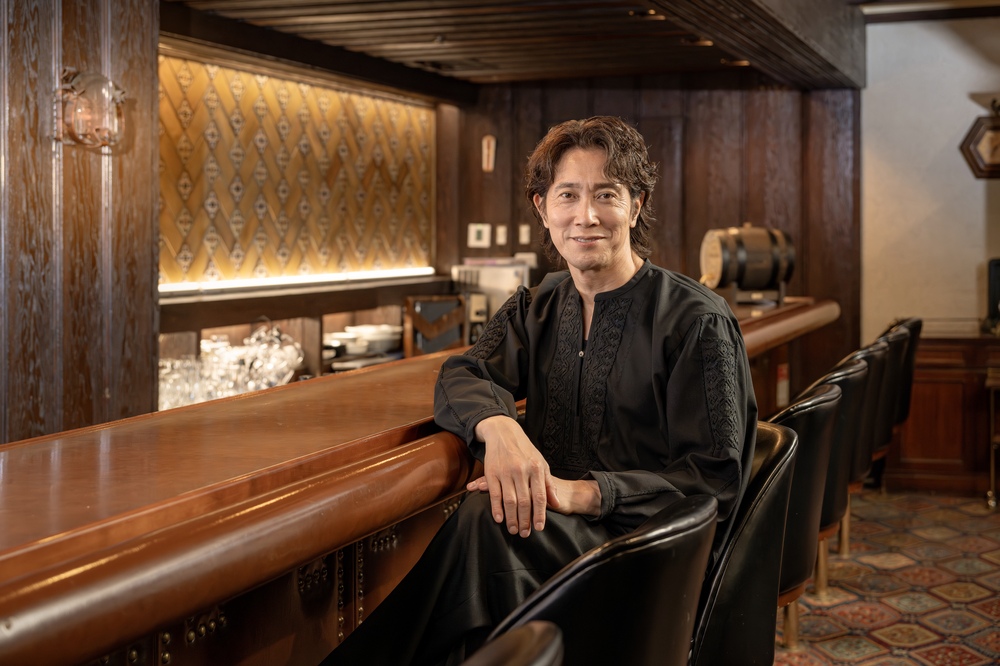
Location / RIHGA Royal Hotel Kyoto Bar GRANADA
Hair and makeup / Shinichiro(IKEDAYA TOKYO)
Stylist / Norihito Katsumi(Koa Hole inc.)
Costume provided by / Shirt:SARTO【info@sarto-designs.com】
Pants:Kiivu【BLANDET Tokyo miyamoto@miyamotospice.com】
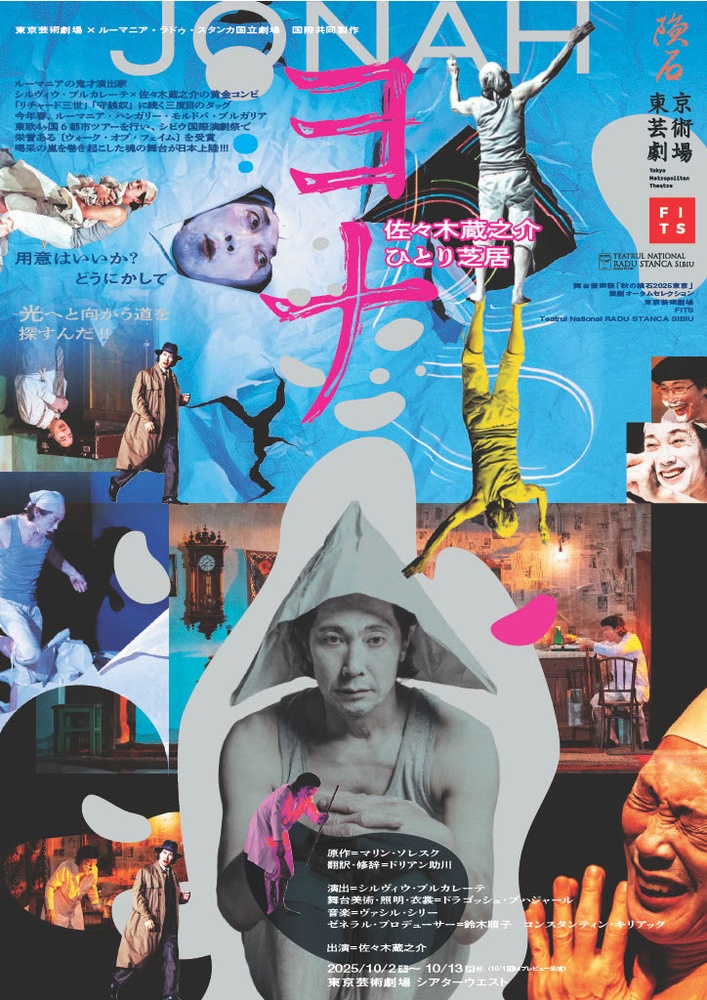
Kuranosuke Sasaki in the one-man play Jonah
This new stage production was created as an international co-production between the Tokyo Metropolitan Theatre and the Radu Stanca National Theatre of Romania based on a play by Marin Sorescu, one of Romania’s leading poets, drawing on the biblical figure of Saint Jonah from the Old Testament. The performance was developed on-site by Kuranosuke Sasaki, who went to Romania alone, and the renowned Romanian director Silviu Purcărete. It was presented first in four Eastern European countries to great acclaim. The Japan tour started October 1, 2025 at the Tokyo Metropolitan Theatre, with performances also scheduled for Kanazawa, Matsumoto, Mito, Yamaguchi, and Osaka.
https://www.geigeki.jp/performance/
theater377/
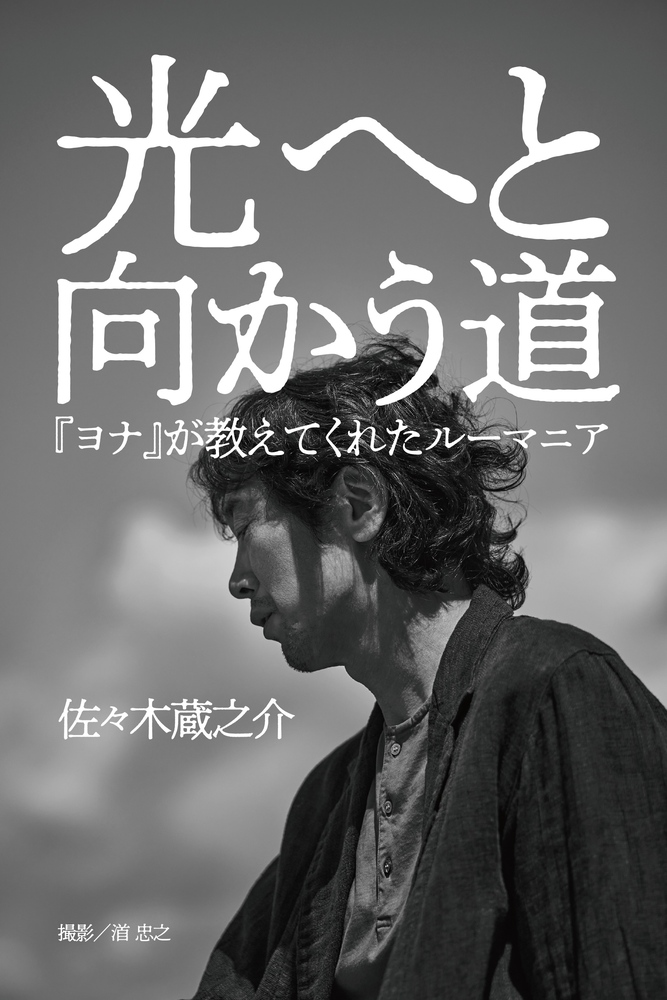
Kuranosuke Sasaki photobook:
A Path Toward the Light: What Jonah Taught Me About Romania
A photobook documenting the Jonah European tour, featuring behind-the-scenes shots and new photos of the beautiful city of Sibiu, has been on sale since September 14.
Currently on sale from the Anchor shop
Also available at each theater venue during the Jonah tour
https://shop.anchor-mg.com/
Kuranosuke Sasaki
Kuranosuke was born in Kyoto Prefecture in 1968. He co-founded the theater company Planet Pistachio, and moved to Tokyo after he left the troupe. In 2000, his performance in the NHK serial drama Audrey drew widespread attention, and he has since appeared in numerous television, film, stage, and other productions. Major awards include: the Japan Academy Film Prize, Award for Excellence for Best Actor for Samurai Hustle (2015), Japan Academy Film Prize, Award for Excellence for Best Supporting Actor for Aircraft Carrier Ibuki (2020), and the Kyoto Prefecture Cultural Award for Distinguished Service (2023), among many others.
Kuranosuke Sasaki Fan Site
“TRNSIT” https://sasaki-kuranosuke.com
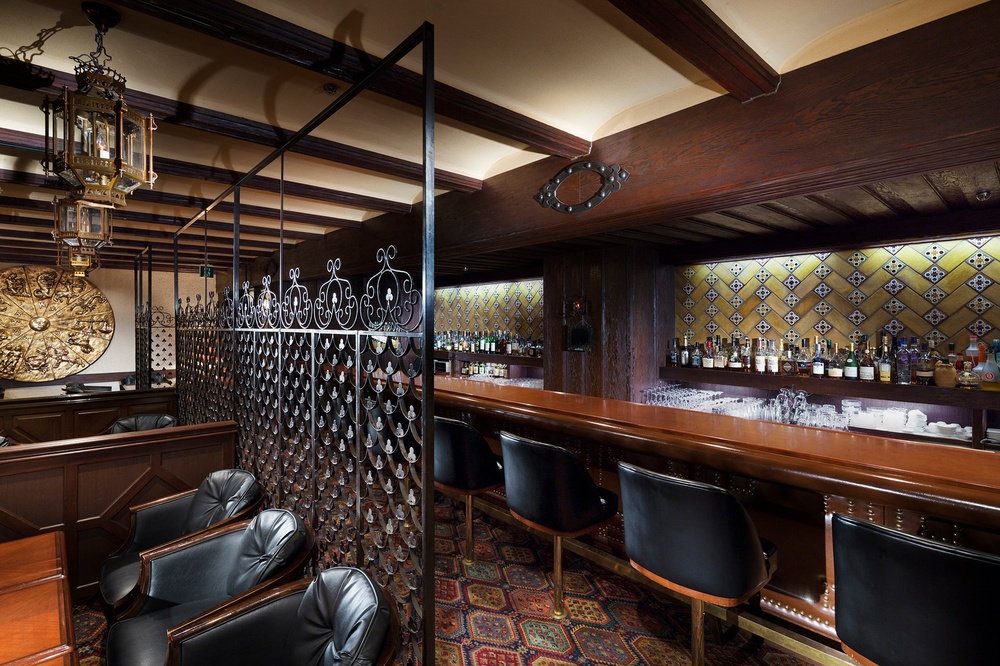
RIHGA Royal Hotel Kyoto
Bar GRANADA
Phone: +81(0) 75-361-9224
1st Basement Floor,1-Taimatsu-cho, Shiokoji-sagaru, HigashiHorikawa-dori, Shimogyo-ku, Kyoto
Share



Like