

Fresh, New Modernism Costume by Ryohei Koiso
ROYAL GALLERY
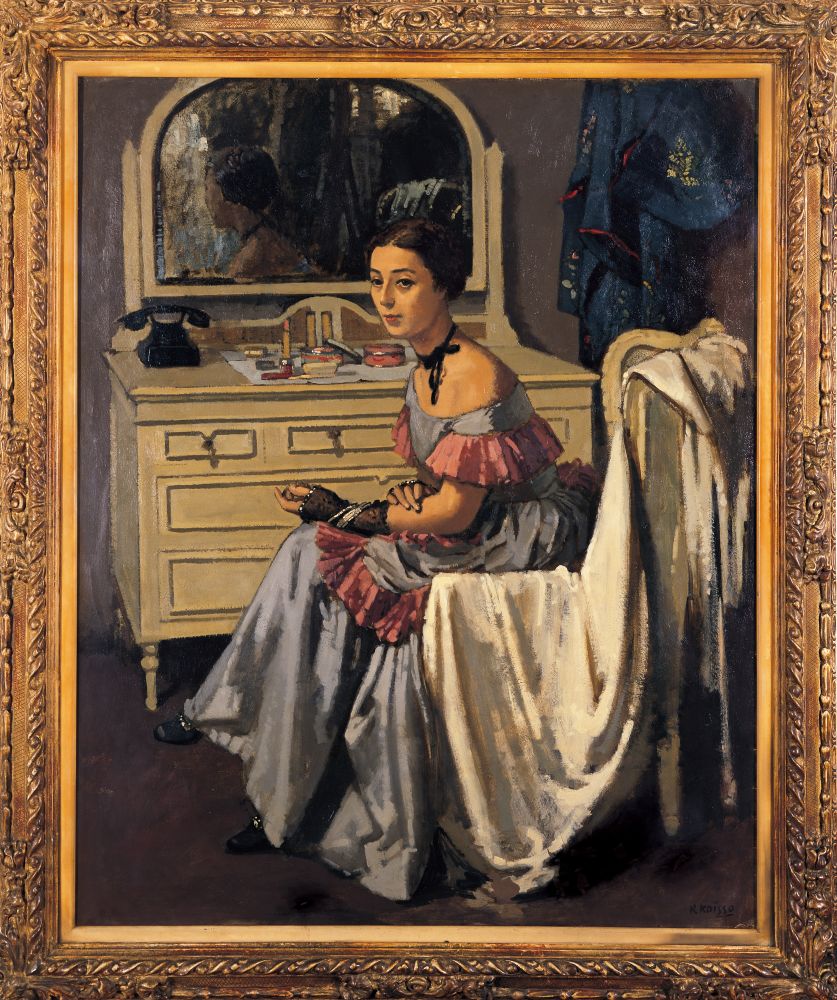
A woman sits before a dressing table. Her expression is sharp and focused, her hands wearing fingerless gloves, her hair styled high in Western fashion, and her body draped in an elegant costume. Hanging on the chair is what appears to be a large white shawl or gown. The artist, Ryohei Koiso (1903–1988), was a leading Western-style painter of the modern era, renowned for his masterful realism and refined figure painting. Born in Kobe in 1903, he spent most of his career there, and is considered a painter representative of the modernism of that exotic city.
Tracing Koiso’s artistic career, he entered the Western Painting Department of Tokyo Fine Arts School (known today as Tokyo University of the Arts) in 1936 after graduating from Hyogo Prefectural Second Kobe Middle School (today Hyogo Senior High School, which also counts the Nihonga (Japanese-style) painter Higashiyama Kaii among its alumni). While still a student, he demonstrated his talent early, winning the Special Prize at the Imperial Art Academy Exhibition (Teiten) in 1926 with his Portrait of Miss T. The following year, he submitted His Rest, featuring his friend the poet Iku Takenaka (known for works such as the poetry collection Ivory Coast, published in 1932), and Self-Portrait (both in the collection of The University Art Museum, Tokyo University of the Arts) as his graduation works, earning the highest marks and graduating at the top of his class.
In 1928, he studied abroad in France, where he was deeply struck by Paolo Veronese’s The Wedding at Cana (1563) at the Louvre Museum. This Venetian School painting depicts the miracle from the New Testament which Jesus Christ performed at a wedding banquet in the town of Cana, and portrays over a hundred figures. Inspired by this work, Koiso made group compositions featuring numerous figures a lifelong theme.
After returning to Japan, he participated in the founding of the Shinseisakuha Kyokai (today the Shinseisaku Kyokai (New Production Association)) in 1936, and after the war served as a professor at Tokyo University of the Arts. He maintained studios in both Kobe and Zushi City in Kanagawa Prefecture, and in 1974 at the age of 71, he created the murals Painting and Music for the grand hall of the State Guest House, Akasaka Palace, Tokyo, as a culmination of his study of group compositions. He also designed curtains for the Kobe Bunka Hall and the Takarazuka Grand Theater.
The English word “costume” used in the above painting’s title refers not only to clothing specific to a particular region, era, or ethnic group, but also to attire worn for the stage, balls, or masquerades. Given her dress, the woman in the painting may be a ballerina or an opera singer. A kimono hangs on the wall at the back right, and the mirror seems to reflect other garments. While the work was undoubtedly created in Koiso’s studio, one can imagine that the composition was conceived based on the image of someone waiting in a dressing room for their turn on stage.
Between about 1935 and 1939, Koiso painted Dancer, a work featuring a ballerina as its subject. In 1939, he also created a series depicting a woman who worked as a fashion designer in a dressmaking shop. In a different painting titled Costume, he portrayed a mannequin dressed in a gown standing behind the woman, suggesting that this too was likely set in a dressmaker’s shop. Koiso’s paintings of dancers and dressmaking scenes show the influence of the Impressionist Edgar Degas (1834–1917), known for his depictions of ballerinas. Each of these works possesses an air of refinement while remaining charmingly understated.
Koiso’s Costume, held in the collection of the RIHGA Royal Hotel, was painted in 1935 and can be regarded as the starting point of this series of female portraits. Features like the placement of the woman at the center of the picture and the classical beauty of form created by its solid, balanced composition suggest that, had the Imperial Art Academy Exhibition (Teiten) been held that autumn, it might well have been submitted there. (The exhibition was disrupted that year due to reorganization of the Imperial Art Academy by Minister of Education Genji Matsuda.)
This work was displayed from an early stage in the Hotel New Osaka, an eight-story Venetian Gothic–style building established in 1935 at the request of Osaka’s political and business leaders to create a modern hotel for distinguished guests in Osaka. The hotel, the predecessor of today’s RIHGA Royal Hotel Osaka, also featured works such as Narashige Koide’s Portrait of Chou-Chiu-Lan and paintings by Ryuzaburo Umehara and Sotaro Yasui. As an oil painting befitting a modern hotel of high standing, this was regarded as one of the hotel’s symbolic artworks.
Koiso passed away in 1988 at the age of 85. Around 2,000 of his works were donated by his family to the City of Kobe, and in 1992 the Kobe City Koiso Memorial Museum of Art opened on Rokko Island. In the museum’s courtyard stands the artist’s studio, originally built in 1949 in Sumiyoshi-yamate, Higashinada Ward, Kobe, and relocated to the museum to allow visitors to experience his creative environment firsthand. That same year saw the establishment of the Exhibition of R. KOISO Grand Prize, a public competition that continued through its tenth iteration in 2013. The modern, luminous, fresh, and new art of Ryohei Koiso can still be admired today at the Koiso Memorial Museum of Art and the RIHGA Royal Hotel Osaka.
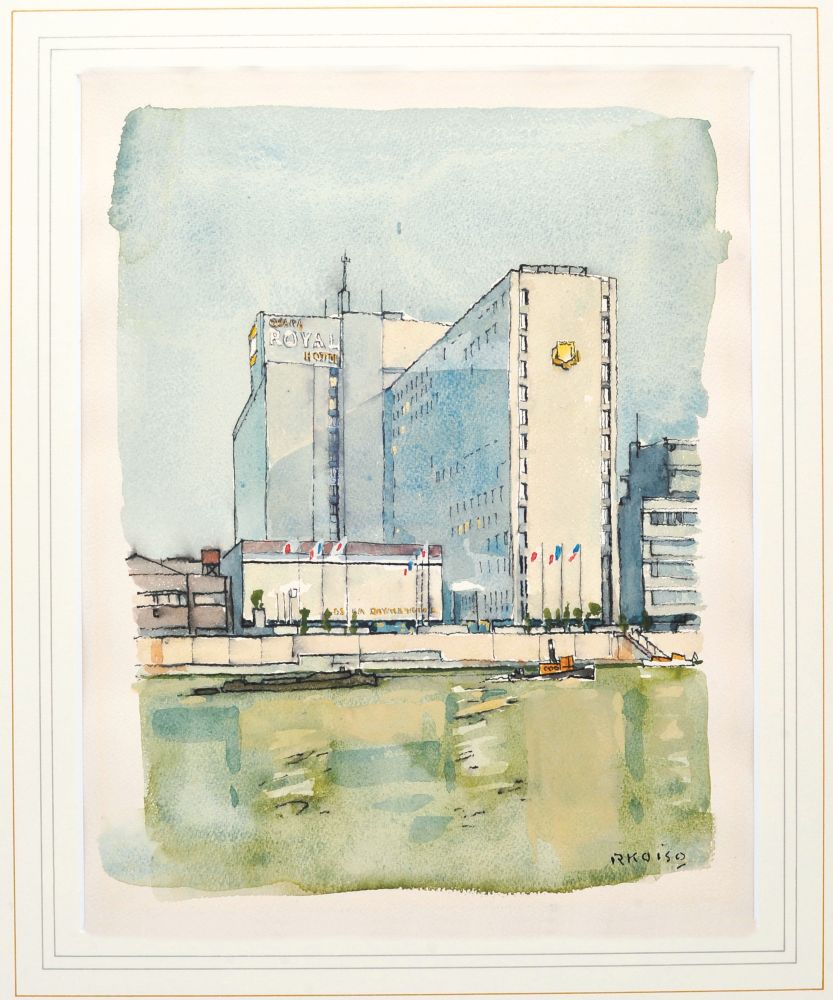
A painting by Ryohei Koiso titled Osaka Royal Hotel hangs at the entrance to the École de Royal cultural classroom at the RIHGA Royal Hotel Osaka. Painted thirty years after Costume, this is a watercolor of the Osaka Royal Hotel, a building constructed with the aim of internationalization. The hotel originally opened on part of the current site (West Wing). Judging from the length of the sunlight falling from the north side of the hotel, it appears to be early summer, and one can sense a refreshing breeze over the surface of the river.
Text by Setsuya Hashizume, Professor Emeritus, Osaka University, Japanese and East Asian Art History
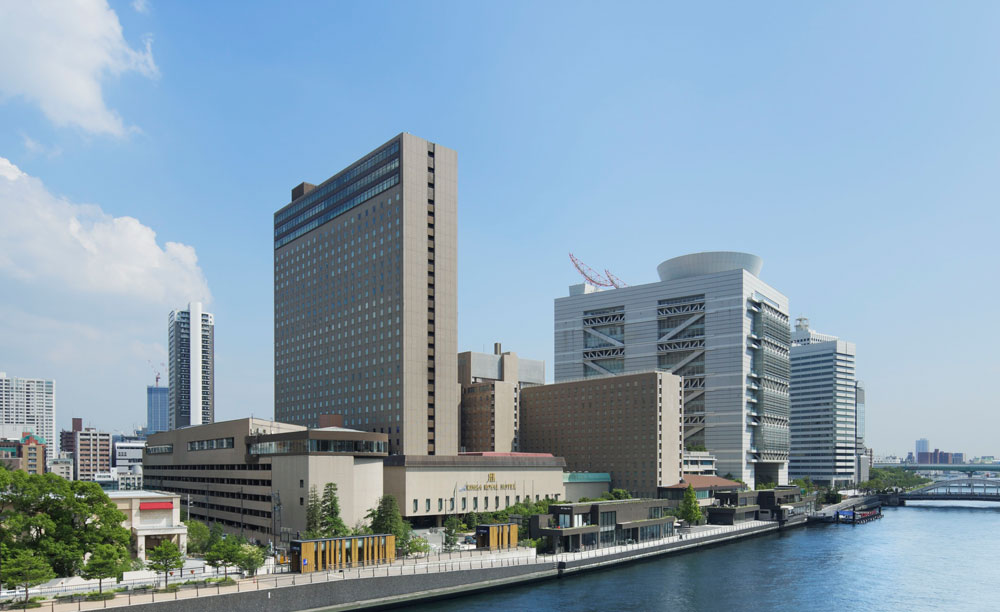
RIHGA Royal Hotel Osaka,
Vignette Collection
TEL +81 (0)6-6448-1121
5-3-68 Nakanoshima, Kita-ku, Osaka, JAPAN
Share



Like